
Fraction Calculator
Add, subtract, multiply and divide fractions. See the simplified result, decimal value, mixed number and calculation steps.
Calculate
Exact result
Worked example
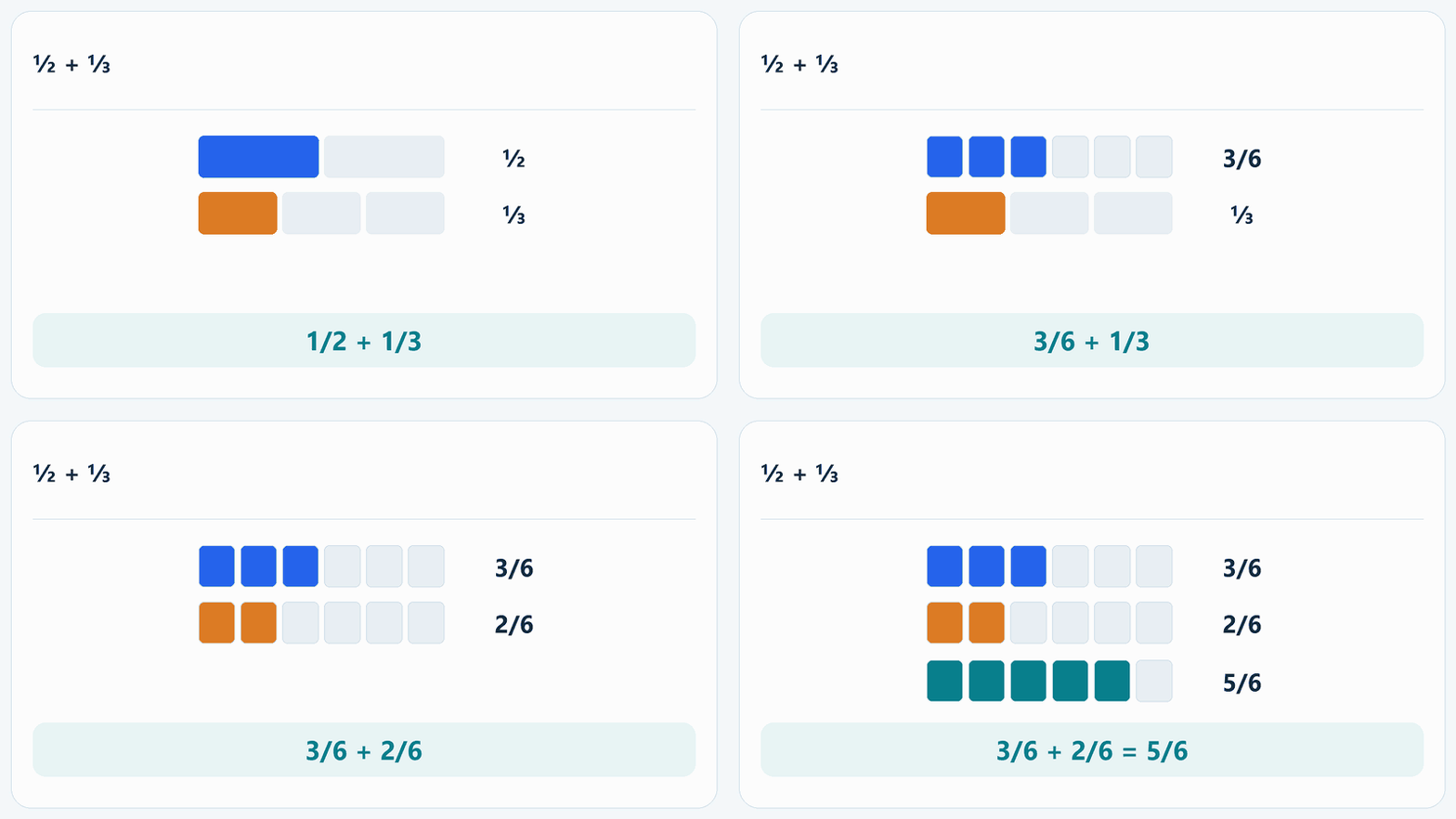
Formula and method
Enter whole numbers in the numerator and denominator fields. Addition and subtraction use a common denominator. To divide, multiply by the reciprocal of the second fraction. The exact result is reduced automatically.
How to use the calculator
Use this calculator whenever you need the exact result of adding, subtracting, multiplying or dividing two fractions. It shows the arithmetic with a common denominator or reciprocal where needed, then reduces the result to lowest terms.
- Enter a whole number in each numerator and denominator field. To enter an ordinary integer such as 4, write it as 4/1. Both denominators must be nonzero.
- Choose the operation in the middle of the form. For subtraction and division, enter the fractions in the same order as in the original problem.
- Read the answer and follow the working underneath it. If you start with a mixed number such as 2 ⅓, first convert it to 7/3.
Worked examples
Subtract 1/6 from 3/4
Twelfths are the smallest equal pieces that work for both denominators. Three quarters become nine twelfths and one sixth becomes two twelfths. Subtract the numerators and keep 12 as the denominator. Seven and twelve have no common divisor above one.
Multiply 2/3 by 3/5
Multiplying the numerators gives 6 and multiplying the denominators gives 15. Both share a factor of 3, so the result reduces to 2/5. Cancelling that factor before multiplying makes the arithmetic quicker by hand.
How to read the result
The main answer is an exact fraction or integer. The decimal is handy for comparing sizes and may be rounded. An improper fraction with a nonzero remainder can also appear as a mixed number, such as 15/8 = 1 ⅞.
Frequently asked questions
Why can’t I add the denominators?
A denominator tells you the size of a piece. Put the fractions in pieces of equal size first, then add the counts. For 1/4 + 1/4, two quarters make 1/2.
Can I divide by 0/5?
Division by a fraction requires its reciprocal. For 0/5 the reciprocal would have a zero denominator, so the calculation is undefined.
Where does the minus sign go?
A minus sign on the numerator or the denominator gives the same negative fraction. The calculator writes the sign with the numerator and keeps the denominator positive.