
Ratio and Proportion Calculator
Solve proportions and find the missing value in two equivalent ratios. Enter any three terms and see the exact answer and cross multiplication.
Calculate
Missing term
Worked example
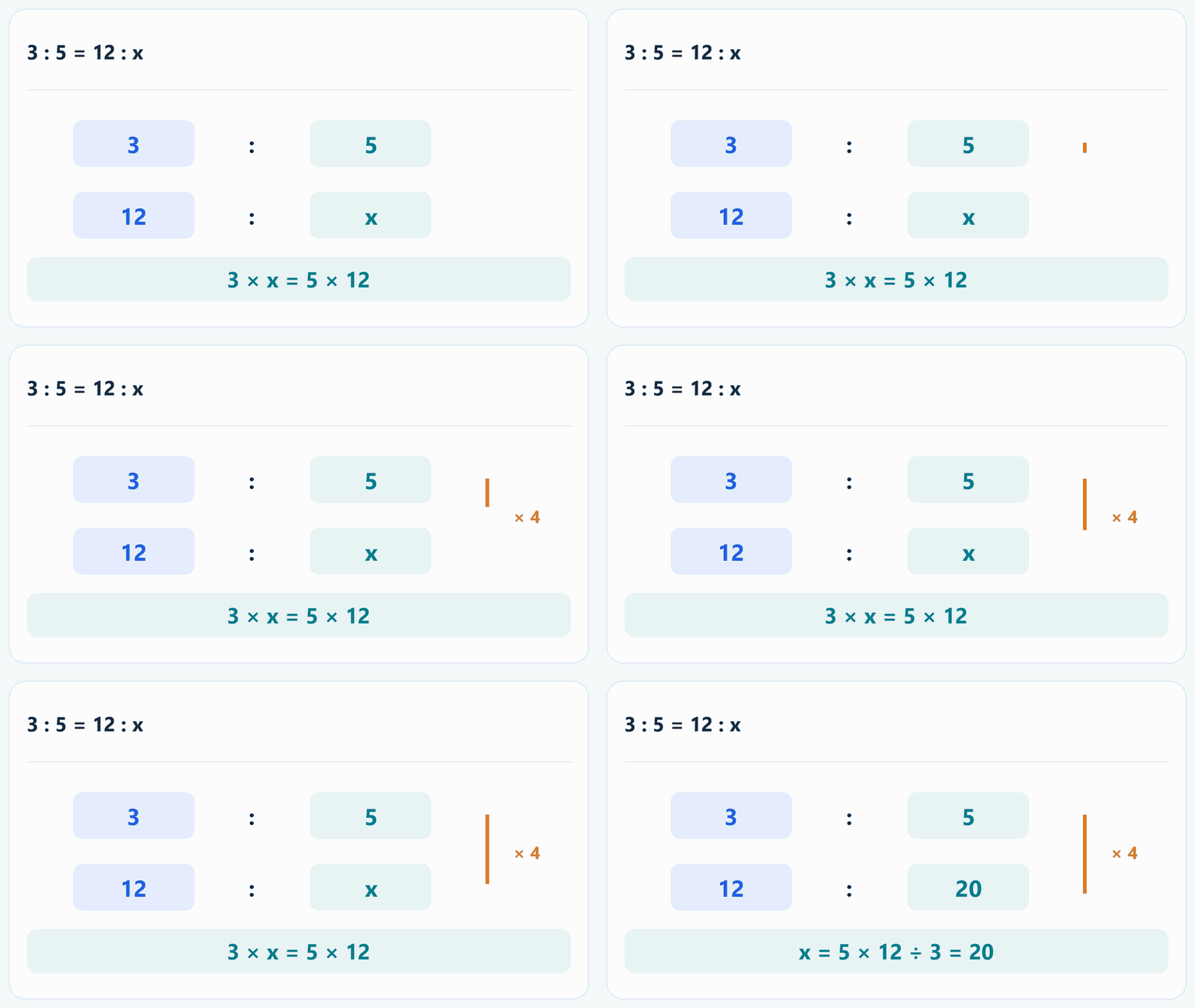
Formula and method
Leave the unknown term blank. In a/b = c/d, the cross products a × d and b × c are equal. The two denominators must be nonzero, and some combinations have no unique solution.
How to use the calculator
A proportion says that two ratios have the same value. Use it to resize a recipe, read a scale drawing or find a unit price when the quantities change at a constant rate. Enter three known values to solve for the fourth.
- Put the quantities in the same order in both ratios. If A and C are milliliters, keep B and D as serving counts. Convert units before entering values if the same quantity type is measured differently on each side.
- Fill in any three of A, B, C and D. Leave the missing number empty. A zero and an empty field have different meanings.
- Calculate, then look at the letter next to the answer. Give the number the unit that belongs to that position and check it against the original ratios.
Worked examples
Scale a recipe from 4 to 10 servings
Suppose four servings take 250 mL of broth. Enter 250 for A, 4 for B and 10 for D, leaving C blank. Each serving takes 62.5 mL, so ten servings take 625 mL. The multiplication by 10/4 keeps the quantity per serving constant.
Read a map at 1 to 25,000
One centimeter on this map corresponds to 25,000 centimeters on the ground. Enter A = 1, B = 25000 and C = 6 to find D. Six centimeters represent 150,000 centimeters, or 1.5 km.
How to read the result
The line below the answer shows how the unknown was isolated. Cross-multiplying gives A × D = B × C. Multiplying the known pair and dividing by the remaining known value solves for the missing term when it has a unique valid value. The calculator can show an exact fraction and its decimal form.
Frequently asked questions
Can I enter decimals?
Yes. Enter each number in its own field. The exact fraction can be useful when the decimal display is rounded, such as when the missing value is one third.
Why do I get an error with zero?
B and D are denominators and must be nonzero. A zero in a numerator can also make some equations impossible or give more than one solution. The calculator returns a value only when it can determine a single valid answer.
When should I avoid using a proportion?
Check that the amount per unit stays constant. A delivery charge that includes a fixed fee or a discount after a certain quantity needs a separate calculation.