
Lang
Math & Number Tools Calculator
Logarithm Calculator
Use this free Logarithm Calculator to calculate logarithm with a cleaner layout, instant results, formulas, examples, and helpful interpretation notes.
Powerful Logarithm Calculator
About the Logarithm Calculator
The Logarithm Calculator is a powerful tool designed to simplify complex calculations involving logarithms. Whether you’re a student, professional, or just someone who needs to perform quick mathematical operations, this calculator has got you covered.
Understanding Logarithms
A logarithm is the inverse operation to exponentiation. In simpler terms, a logarithm answers the question: To what power must a given number (the base) be raised to obtain another number (the argument)? For example, in the expression \(\log_b(a) = c\), \(b\) is the base, \(a\) is the argument, and \(c\) is the result. This can be rewritten as \(b^c = a\).
Examples of Logarithms
Let’s look at some examples to better understand how logarithms work:
- \(\log_2(8) = 3\) because \(2^3 = 8\)
- \(\log_5(25) = 2\) because \(5^2 = 25\)
- \(\log_{10}(1000) = 3\) because \(10^3 = 1000\)
Natural Logarithms
A natural logarithm is a logarithm with base \(e\) (Euler’s number, approximately 2.71828). The natural logarithm of a number \(x\) is denoted as \(\ln(x)\). For example:
- \(\ln(e) = 1\) because \(e^1 = e\)
- \(\ln(e^2) = 2\) because \(e^2 = e^2\)
- \(\ln(1) = 0\) because \(e^0 = 1\)
Common Logarithms
A common logarithm is a logarithm with base 10. The common logarithm of a number \(x\) is denoted as \(\log_{10}(x)\) or simply \(\log(x)\). For example:
- \(\log_{10}(10) = 1\) because \(10^1 = 10\)
- \(\log_{10}(100) = 2\) because \(10^2 = 100\)
- \(\log_{10}(1) = 0\) because \(10^0 = 1\)
Change of Base Formula
The change of base formula allows you to compute logarithms with any base using logarithms with a different base. The formula is \(\log_b(a) = \frac{\log_c(a)}{\log_c(b)}\), where \(c\) is any positive number other than 1. For example, to find \(\log_2(8)\) using the natural logarithm:
- \(\log_2(8) = \frac{\ln(8)}{\ln(2)} = \frac{2.0794}{0.6931} \approx 3\)
How to Use the Logarithm Calculator
Using the Logarithm Calculator is straightforward. Simply enter the base and argument values, and the calculator will compute the result for you. You can also enter the result and one of the other values to solve for the missing variable.
Benefits of Using the Logarithm Calculator
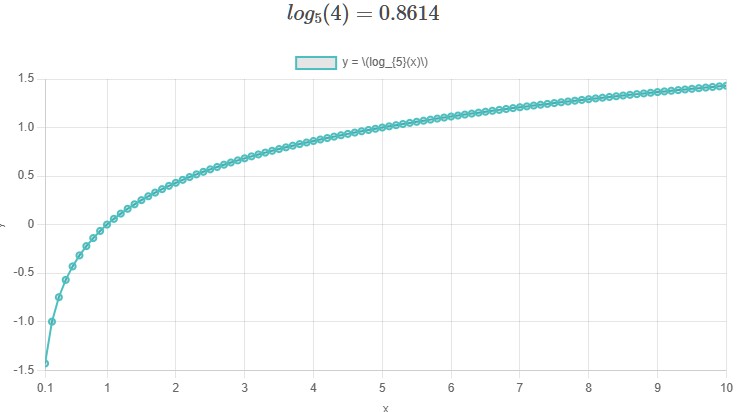
The Logarithm Calculator offers several benefits. It saves time by performing calculations quickly and accurately. It also helps reduce errors that can occur when performing manual calculations. Additionally, it provides a visual representation of the calculation through a chart, making it easier to understand the relationship between the base, argument, and result.
Advanced Features
The Logarithm Calculator includes advanced features such as the ability to calculate logarithms with any base, not just common or natural logarithms. It also supports decimal and fractional inputs, ensuring precision in your calculations. The chart feature provides a dynamic visualization of the logarithmic function, helping you to better understand the behavior of logarithms.
Applications of the Logarithm Calculator
The Logarithm Calculator can be used in various fields, including mathematics, physics, engineering, and finance. It is particularly useful for solving problems related to exponential growth and decay, pH levels, decibel scales, and logarithmic functions.
Exponential Growth and Decay: Logarithms are crucial in modeling exponential growth and decay, such as population growth, radioactive decay, and compound interest calculations.
pH Levels: In chemistry, pH is defined as the negative logarithm of the hydrogen ion concentration in a solution. The Logarithm Calculator can help determine pH levels accurately.
Decibel Scales: Sound intensity is often measured on a logarithmic scale called decibels. The Logarithm Calculator can assist in converting between sound intensity and decibel levels.
Logarithmic Functions: In mathematics, logarithmic functions are used in various applications, including solving equations, analyzing data, and understanding complex systems.
Conclusion
In conclusion, the Logarithm Calculator is an essential tool for anyone who needs to perform calculations involving logarithms. Its user-friendly interface and accurate results make it a valuable resource for both students and professionals. Try it out today and experience the power of the Logarithm Calculator!
Contact us at office@calculator-convert.com
Follow us on Facebook
How to use this calculator
- Enter the values requested by the Logarithm Calculator.
- Use the optional fields when they match your real situation.
- Read the result, then compare it with the formula notes and examples below.
Accuracy tips
- Keep intermediate values visible when possible so you can spot typing mistakes.
- Use the examples to confirm whether the calculator expects percentages, decimals, or whole numbers.
- If the answer is used for school or work, round only after the final calculation.
Why this helps
- Designed for quick math & number tools checks with a focused input area.
- Helpful explanations are kept on the same page so the result is easier to understand.
- The page can be edited directly from the synced WordPress HTML file.
Logarithm Calculator FAQ
How do I use the Logarithm Calculator?
Fill in the fields in the Logarithm Calculator, then press the calculate button or update the inputs to see the result.
Are the Logarithm Calculator results accurate?
The result is an estimate based on the values you enter. It is useful for planning and checking, but important decisions should be verified with the original data or a qualified professional.
Can I use the Logarithm Calculator on mobile?
Yes. The updated layout uses larger inputs, clearer spacing, and responsive cards so the Logarithm Calculator works on phones, tablets, and desktop screens.
Why does this page include formulas and examples?
Formulas and examples make the result easier to audit, help users learn the calculation, and improve the page for search engines without relying on Elementor.
Math & Statistics directory
Need another math or statistics tool?
Browse the full math and statistics calculator collection for percentages, algebra, geometry, probability, z-scores, confidence intervals, regression, correlation, percentiles, matrices, and number conversions.