
Income Planning
Hourly to Salary Calculator
Turn an hourly rate, monthly salary or annual salary into a clear pay plan. Compare two job offers, account for leave and overtime, and see exactly how each result is calculated.
Changing currency changes the display only. It does not convert exchange rates.
Job offer A
Pay and work schedule
Monthly and annual inputs are base pay for the full schedule, before unpaid leave, overtime and bonuses.
Enter scheduled workdays, not calendar days. Paid leave preserves regular pay; both types of leave reduce worked hours and assumed overtime.
Overtime and extras
Use the multiplier that applies to your agreement. 1.5 is an example, not a universal legal rule.
Estimated non-cash value, shown separately. It is not added to take-home pay or treated as an employee deduction.
Estimated deductions
Both percentages are applied independently to gross pay. Fixed deductions are multiplied by 12. This simplified model does not apply tax brackets or pre-tax relief.
Do not include separately entered retirement contributions or fixed deductions in the tax percentage. Displayed figures are rounded; calculations use full precision.
Job offer B
Pay and work schedule
Monthly and annual inputs are base pay for the full schedule, before unpaid leave, overtime and bonuses.
Enter scheduled workdays, not calendar days. Paid leave preserves regular pay; both types of leave reduce worked hours and assumed overtime.
Overtime and extras
Use the multiplier that applies to your agreement. 1.5 is an example, not a universal legal rule.
Estimated non-cash value, shown separately. It is not added to take-home pay or treated as an employee deduction.
Estimated deductions
Both percentages are applied independently to gross pay. Fixed deductions are multiplied by 12. This simplified model does not apply tax brackets or pre-tax relief.
Do not include separately entered retirement contributions or fixed deductions in the tax percentage. Displayed figures are rounded; calculations use full precision.
Target salary and pay rise
The target includes offer A’s bonus and overtime. Its schedule, leave and overtime multiplier stay unchanged. The pay rise changes only the base rate; fixed bonuses and deductions stay unchanged.
Compare your results
Total compensation value is not the same as cash in your bank account.
Offer B minus offer A
Where annual gross pay comes from
How gross pay is allocated
| Pay period | Job offer A | Job offer B | ||
|---|---|---|---|---|
| Gross | Estimated net | Gross | Estimated net | |
Annual totals, including bonuses, are averaged over 52 weeks, 26 biweekly periods, 24 twice-monthly periods or 12 months. Daily and hourly figures use paid days and paid hours. Actual payroll dates and individual payments may differ.
Target salary and pay rise
See every calculation
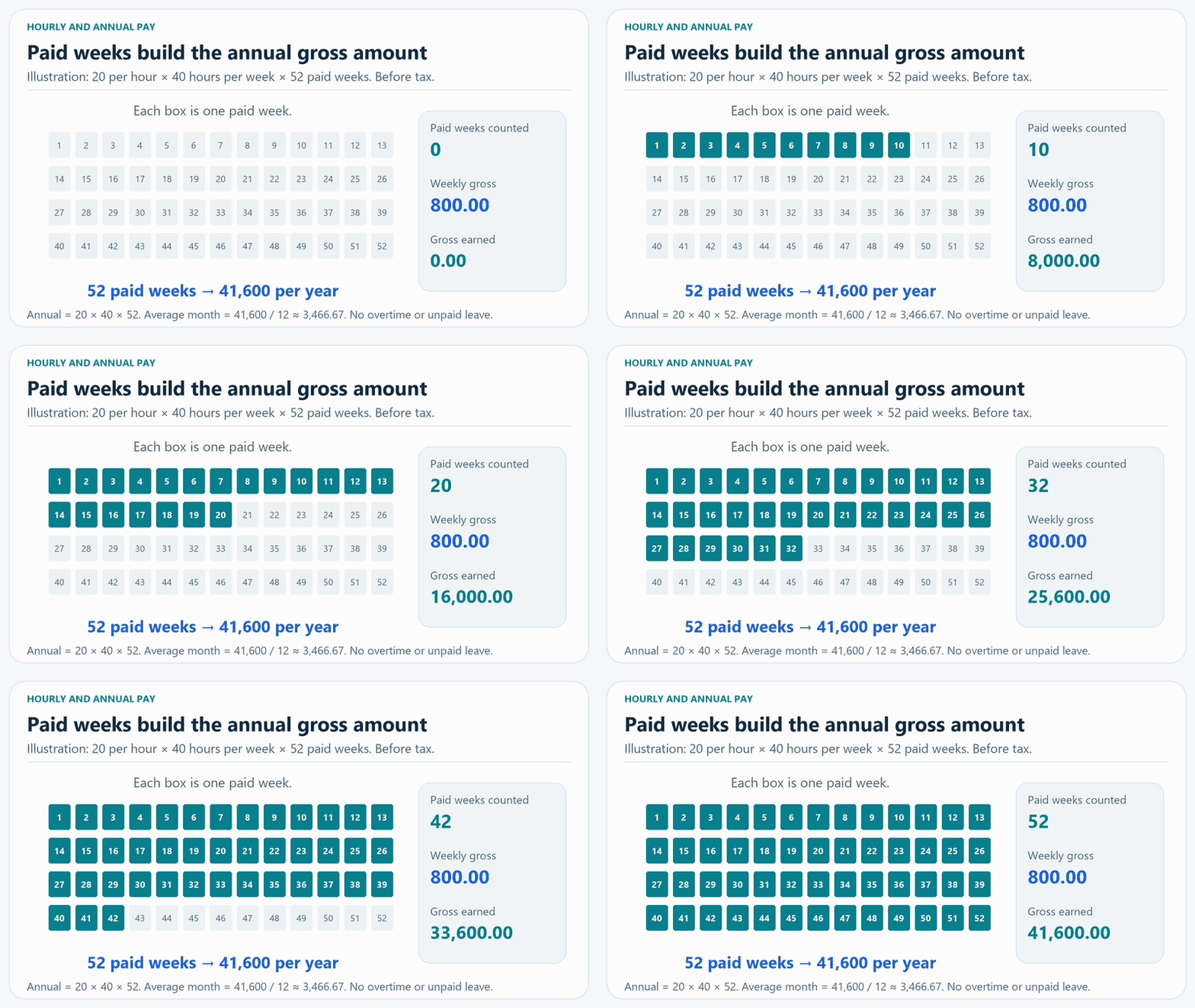
Paid weeks build the annual gross amount
Compare the same things
Use the same currency for both offers. Compare gross and net pay, the hours actually worked, paid leave and employer-funded benefits. Employer benefits are shown as a separate value, not spendable salary.
Paid leave is still paid
Paid leave reduces time at work without reducing regular pay. Unpaid leave reduces both paid and worked time. Overtime is assumed only during worked weeks. Fractional days let you model part-days or an average schedule.
Why net pay is only an estimate
Actual payroll depends on your country, tax status, contribution rules and contract. Enter your own estimated percentages and deductions. The calculator applies each percentage to gross pay; it does not calculate progressive taxes, contribution caps or pre-tax retirement relief.
Quick hourly pay examples
Questions about hourly pay and salary
How do I convert hourly pay into annual salary?
Multiply the hourly rate by paid regular hours, add overtime at the selected multiplier, then add the annual cash bonus. Paid leave stays paid; unpaid leave reduces paid hours.
How do I convert annual or monthly salary into an hourly rate?
Divide annual base salary, or monthly base salary multiplied by 12, by the full scheduled regular hours. In this planner the base salary input is before unpaid leave, overtime and bonuses.
Is biweekly pay the same as twice-monthly pay?
No. This planner uses 26 biweekly periods and 24 twice-monthly periods per year. These are annual averages; some payroll calendars can contain an extra pay date.
Do employer benefits count as net salary?
No. Employer-funded benefits are shown separately in total compensation. Employee deductions reduce estimated net pay. Do not enter the same amount in both fields.
Does the calculator know my country’s tax or overtime rules?
No. The tax percentages and overtime multiplier are assumptions you supply. The calculator is a planning tool, not a payroll calculation or legal determination.
Calculations run in your browser. The pay values you enter are not sent to our server by this tool.
Finance & Business directory
Need another money tool?
Browse the full finance calculator collection for mortgage payments, loans, paychecks, debt payoff, savings, retirement, ROI, pricing, taxes, and everyday money decisions.