
Compound Interest Calculator and Savings Planner
Explore how starting capital, regular deposits and compound interest work together. Compare plans, see full calculations and estimate the effect of inflation and an optional annual fee.
Build your savings plans
Currency changes display only; there is no exchange-rate conversion.
Inflation is optional. Leave blank to omit purchasing-power results. Examples are assumptions, not current inflation or offered interest rates.
Try an illustrative example
Plan A
Plan B
Interest and deposits have separate frequencies. Between deposits the model uses the equivalent exponential growth factor, including fractional periods. The fee acts as a proportional reduction spread over time: after a full year its fee-only factor is one minus the fee rate. This is a planning convention, not a bank’s posting schedule.
Only full scheduled deposits are included. Beginning-of-period deposits are made when a period starts before the horizon; end-of-period deposits are made only when that period finishes. No prorated partial deposit is added. A zero-duration plan has no deposits.
Your compound growth results · Plan A
See savings and compound growth over time
Horizontal axis: elapsed years. Vertical axis: value in the selected currency. Curves use constant assumptions and the specified deposit timing; they are not recorded market prices or guaranteed forecasts.
What makes up the result?
Simple interest versus compound interest
Both illustrations use the same starting capital, nominal annual rate and deposit dates, before fees. Simple interest applies only to contributed capital. If the linear model produces a negative balance, it is marked unavailable rather than presented as a valid savings account.
Detailed growth schedule
The schedule reconciles opening balance, deposits, interest and fees to the closing balance. A partial final interval is included. The table shows at most 120 rows; a final summary row covers any remaining interval.
Compare both savings plans
Plans share the selected currency, inflation and fee assumption, but can have different rates, deposit schedules and durations. Compare equivalent situations; a larger ending balance can simply reflect larger deposits.
Plan a savings target
These calculations use Plan A’s interest, deposit frequency, timing and fee assumptions. Required deposits use its starting capital; required starting capital uses its deposit amount. The target is nominal, not inflation-adjusted.
Minimum amounts are rounded up to two decimal places; the formulas use unrounded values.
Target time uses Plan A’s starting capital and deposits, and searches up to 100 years. It means the first time the model reaches the target, not that the balance will remain above it. Already-reached targets need zero time.
See the full calculation · Plan A
P = starting capital; C = deposit per payment; r = nominal annual rate as a decimal; m = compounding periods per year; d = deposits per year; f = annual fee fraction; T = years; k = net continuous growth rate; S = sum of deposit growth factors.
H = Target balance; T_g = Target planning duration (years); D = Total deposits; I = Interest before fees; E = Estimated fees deducted; i = Assumed annual inflation (%); N = Number of deposits; t_j = Deposit timing; t_0 = Elapsed time; B_0 = Opening balance; S_g = S(T_g).
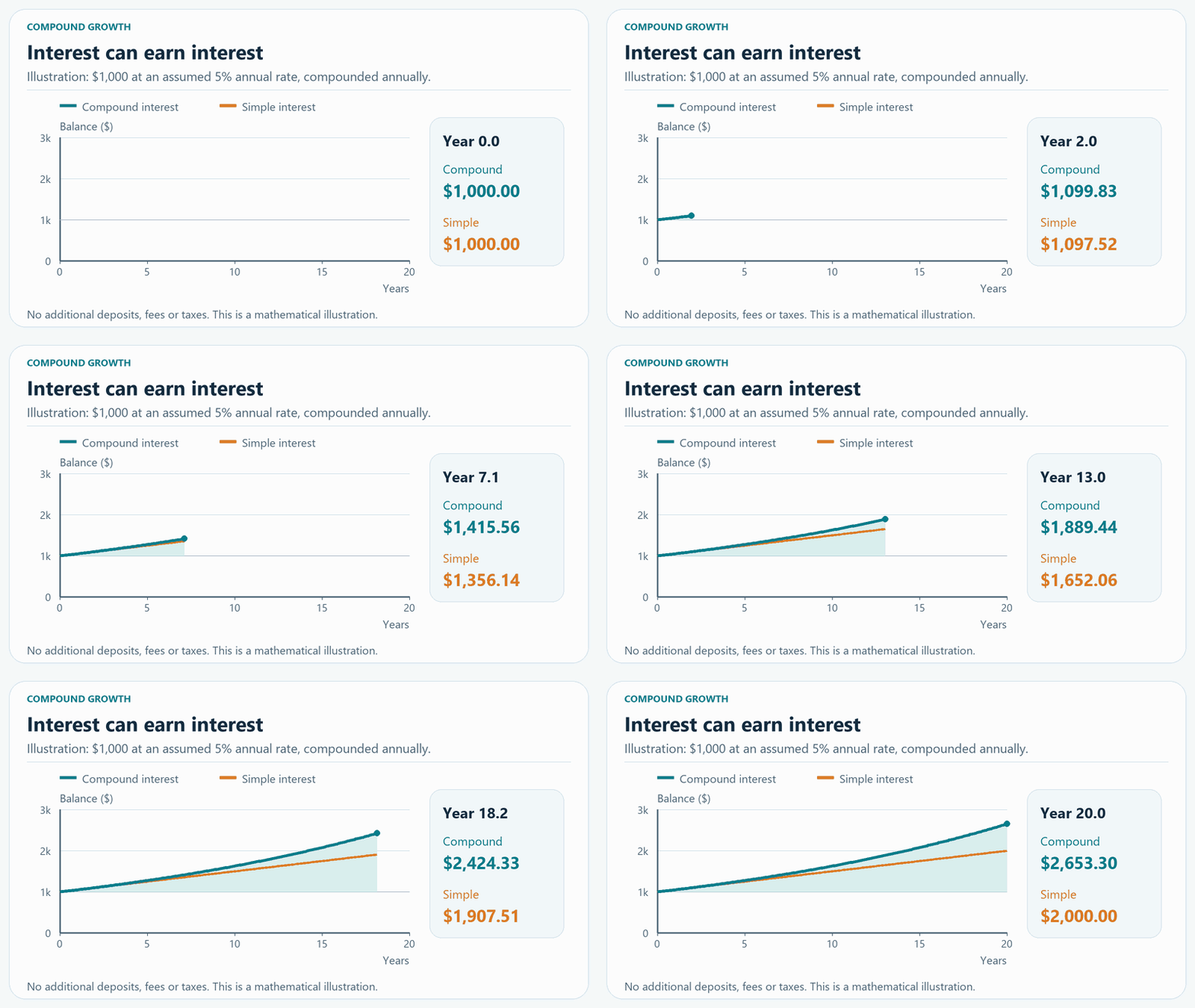
Watch simple and compound interest grow
Understand compounding and the assumptions
Compound interest adds growth to earlier interest as well as to contributed capital. The nominal annual rate and effective annual rate are different when compounding occurs more than once per year. Deposit timing also matters. This model assumes a constant rate, reinvested interest and the stated fee convention. It does not estimate taxes, contract-specific fees, day-count rules or variable market returns.
Calculation references
Compound interest questions
Can I include monthly or weekly deposits?
Yes. Enter an amount per payment and choose its frequency separately from the interest compounding frequency. Beginning and end timing can produce different results.
Does a higher compounding frequency always mean a better offer?
Compare effective annual rates and fees, not nominal rates alone. If offers already quote an effective annual rate, it must not be compounded again as though it were a nominal rate.
Can I enter one and a half years?
Yes. Fractional years are preserved, and months are converted to years without truncation. Only deposits actually scheduled before or at the selected horizon are included.
How are annual fees handled?
The optional fee reduces the balance through a time-proportional exponential factor. Interest and fee amounts are attributed consistently so the balance reconciles. Real providers can charge differently; this is an estimate, not a contract-specific fee calculation.
Why is the simple-interest result different?
Simple interest does not earn interest on earlier interest. Compound growth does. Both comparisons use the same nominal rate, principal and deposit dates, before fees.
Are the projected balances guaranteed?
No. Rates, inflation and fees are assumptions. Actual returns can vary, and taxes or charges not entered here can reduce the outcome.
Calculations run in your browser. The calculator does not send these inputs to its server or save them.