
Retirement Savings Calculator and Income Planner
Follow your savings from today through retirement. Compare contributions, investment growth, inflation, income and withdrawals with a clear monthly model. These are estimates under your assumptions, not guaranteed returns, a safe withdrawal promise or financial advice.
Currency changes formatting only, not exchange rates or country rules. Enter all amounts in the same currency. No automatic pension eligibility, contribution limits, taxes or tax benefits are applied.
The display switch adjusts cards, charts and tables. Input amounts stay unchanged. Current savings and starting contributions are current amounts; future balances are discounted by the elapsed months of inflation.
Your retirement timeline
Use whole years and 0–11 additional months. Retirement may start now; the planning end must be later. The total projection is limited to 100 years. The end age is your planning assumption, not a life expectancy prediction.
Dates mark monthly period ends, not a pension provider’s actual payment calendar.
Build your retirement savings
Personal contributions rise once every 12 months. Employer payments follow the entered percentage, capped at the monthly amount if it is above zero. A zero cap means no modeled cap; it is not an eligibility rule. Contributions are deposited at month-end.
Returns are effective annual rates, converted to monthly factors. The fee is an annual asset percentage, converted monthly and charged after growth but before deposits or withdrawals. It is not simply subtracted from the stated annual return. Transaction charges and taxes are not included.
Plan your retirement income and spending
Spending, pension and other income are entered in today’s purchasing power and inflated to retirement. Afterwards, spending follows inflation and both income sources follow the entered income-growth rate. Income above spending is not added to the investment account.
The full-period target discounts every monthly spending shortfall at the modeled net return, with no required ending balance. The rate benchmark divides the first retirement month’s shortfall multiplied by 12 by your assumed withdrawal rate. Neither target guarantees a safe retirement.
Your estimated retirement plan
Retirement starts now; there is no pre-retirement saving period.
The required contribution is a starting personal amount, with the same annual increases and employer cap as your plan. The search expands as needed rather than stopping at 100,000. It is not an affordability assessment. If retirement starts now and the target is not covered, no future pre-retirement payment can close that gap.
Savings and withdrawals across your timeline
The vertical line marks retirement. The curve shows the deterministic balance under your inputs, not the likelihood of success. Later returns and early market losses can change actual results.
Where your retirement balance comes from
Retirement balance: contributions, growth and fees
Positive and negative components are shown separately; their algebraic sum equals the retirement balance. Fees remain separate from gross investment gains. In the purchasing-power view, all these components are converted at the retirement date to preserve that sum; they are not the purchasing power of each historical payment.
The fee-drag comparison changes only the management fee. It includes fees and the growth no longer earned on those fees. It is different from the sum of fees paid and is not a promised investment result.
Your first retirement-month budget
Each month, income is used first. Investments cover the positive difference only as far as available assets allow. The account never becomes a fictional negative loan. Unfunded spending is tracked separately; unused income is not reinvested.
Retirement income, spending and investment withdrawals
Annual bars distinguish retirement income, planned spending and actual portfolio withdrawals. Unfunded spending remains visible in the table.
What changes your plan?
Each comparison changes only the named assumption; the lower-return case changes both saving and retirement returns. These are sensitivity tests, not probabilities or market predictions. A scenario outside the age or rate limits is unavailable.
Monthly and annual plan
| Period | Age | Period end | Phase | Personal contributions | Employer contributions | Gross investment gain or loss | Asset-management fees paid | Pension and other income | Planned spending | Portfolio withdrawals | Unfunded planned spending | Investment balance |
|---|
Annual periods are counted from the start date and split at retirement when needed, so partial years are retained. Before retirement, retirement income and spending columns are zero. All values follow the display mode. Unfunded spending is not a negative account balance.
Always-visible calculation steps
B = investment balance; q = monthly return factor after fees; C = personal contribution; E = employer contribution; N = retirement months; D = spending less income, floored at zero; W = funded withdrawal; T = target; w = withdrawal-rate assumption; F(C) = projected retirement balance for a starting contribution C. R = Annual gross return before retirement (%) / Annual gross return during retirement (%); f = Annual asset-management fee (%); π = Annual inflation (%); q_B = Net monthly saving-phase factor; q_R = Net monthly retirement-phase factor.
With your values · Future nominal amounts
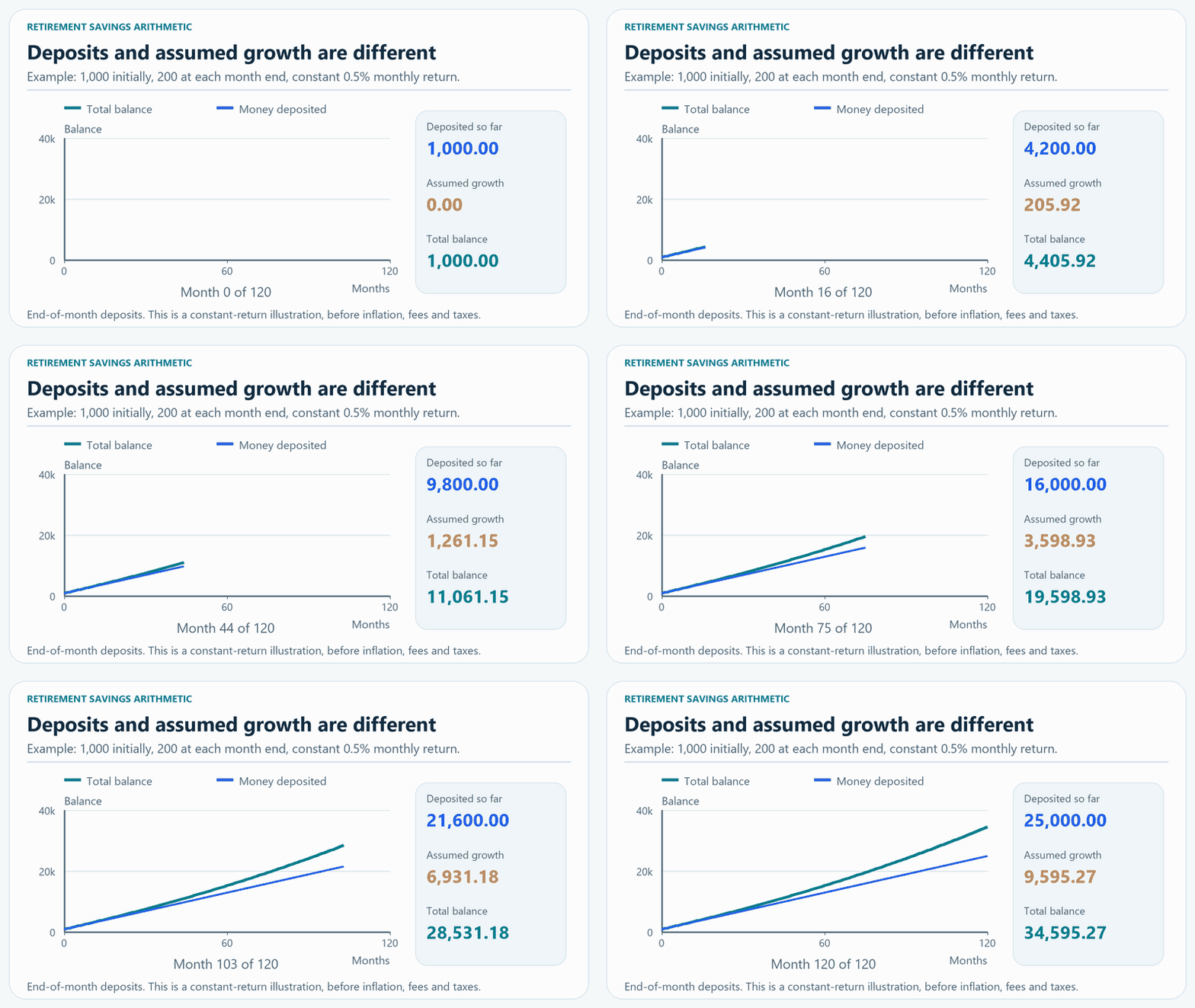
Separate deposits from assumed savings growth
A planning model, not a retirement guarantee
The model uses constant assumed returns, not market volatility or return-sequence simulation. Inflation, fees, longevity, income, taxes and spending can change the outcome. No pension entitlement, tax relief or country-specific account rules are inferred from the selected language or currency. Verify important decisions with a qualified professional.
Sources and planning background
Retirement planning questions
Is the 4% withdrawal assumption guaranteed?
No. It is a comparison assumption, not a safe withdrawal guarantee. A constant-return model cannot capture market volatility or the sequence of losses. The full-period target and cash-flow projection provide separate views under your entered assumptions.
Why show future amounts and today’s purchasing power?
Inflation changes what money can buy. Future amounts are nominal values at each date. Today’s values discount those amounts by the modeled inflation from the start date. The display switch never performs currency exchange.
Does the employer contribution follow my country’s rules?
No. You enter the percentage and optional monthly cap. Real eligibility, vesting, legal contribution limits and taxes must be checked separately. A zero cap means unlimited matching in the model, not an employer promise.
How is the full-period funding target calculated?
For each retirement month, spending minus income is floored at zero and discounted to the retirement date using the modeled net monthly return. The target funds these shortfalls until the entered end age without requiring a remaining inheritance or emergency reserve.
What happens if the investments run out?
Withdrawals cannot exceed available assets. The balance is floored at zero, and spending not funded by income or investments is recorded separately. The first shortfall is a modeled date, not a prediction of your lifespan or actual financial future.
Can I use the planner if I am already retiring?
Yes. Set retirement age to your current age, including the same additional months. Current savings become the retirement starting balance. If that balance is below the chosen target, there is no remaining saving period in which monthly contributions could close the gap.
Calculations run in your browser. This tool does not send your entered savings or income amounts to our server.
Finance and business tools
Looking for another financial calculator?
Explore calculators for mortgages, loans, wages, debt repayment, savings, retirement, investment returns, pricing and taxes.